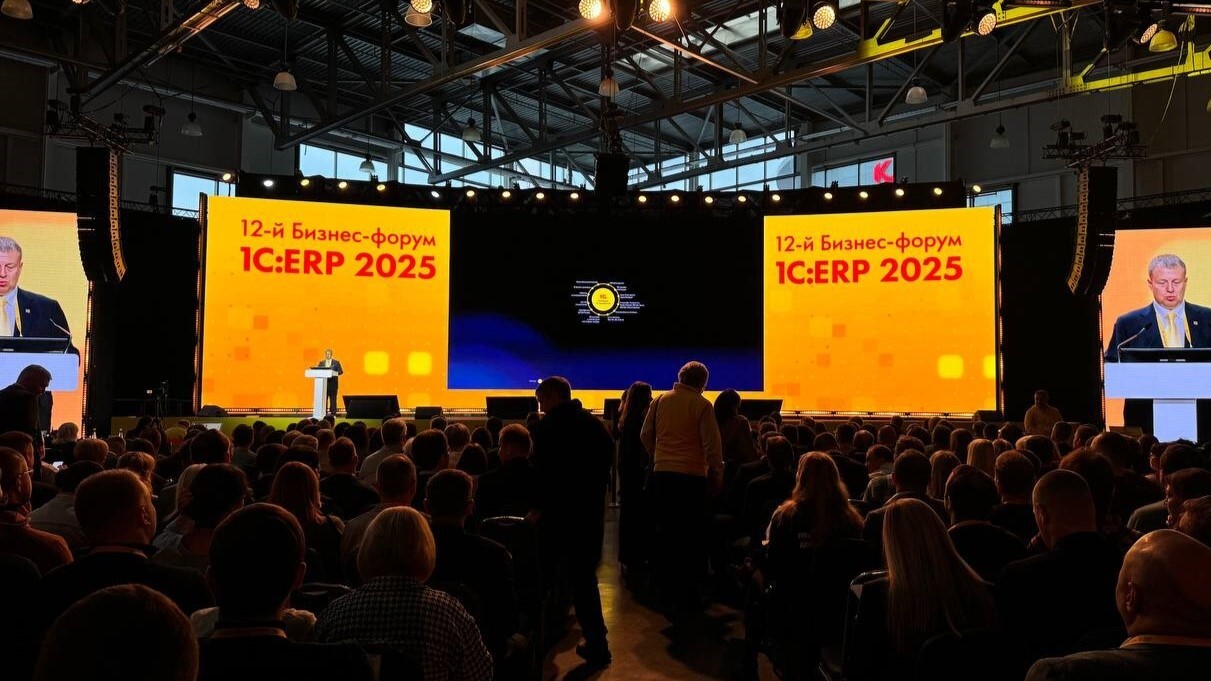
The 12th 1C: ERP 2025 Business Forum, a key event of the year for corporate automation professionals, took place at the Crocus Expo Exhibition Centre, Moscow. The forum traditionally brings together business leaders, leading IT experts, and government representatives to share experiences, discuss digitalization trends, and present new capabilities of solutions based on the 1C: Enterprise 8 platform.
This year, WELLGO presented at the forum in one of the key thematic sections – “Procurement Management, Warehouse, Logistics and Transport”.
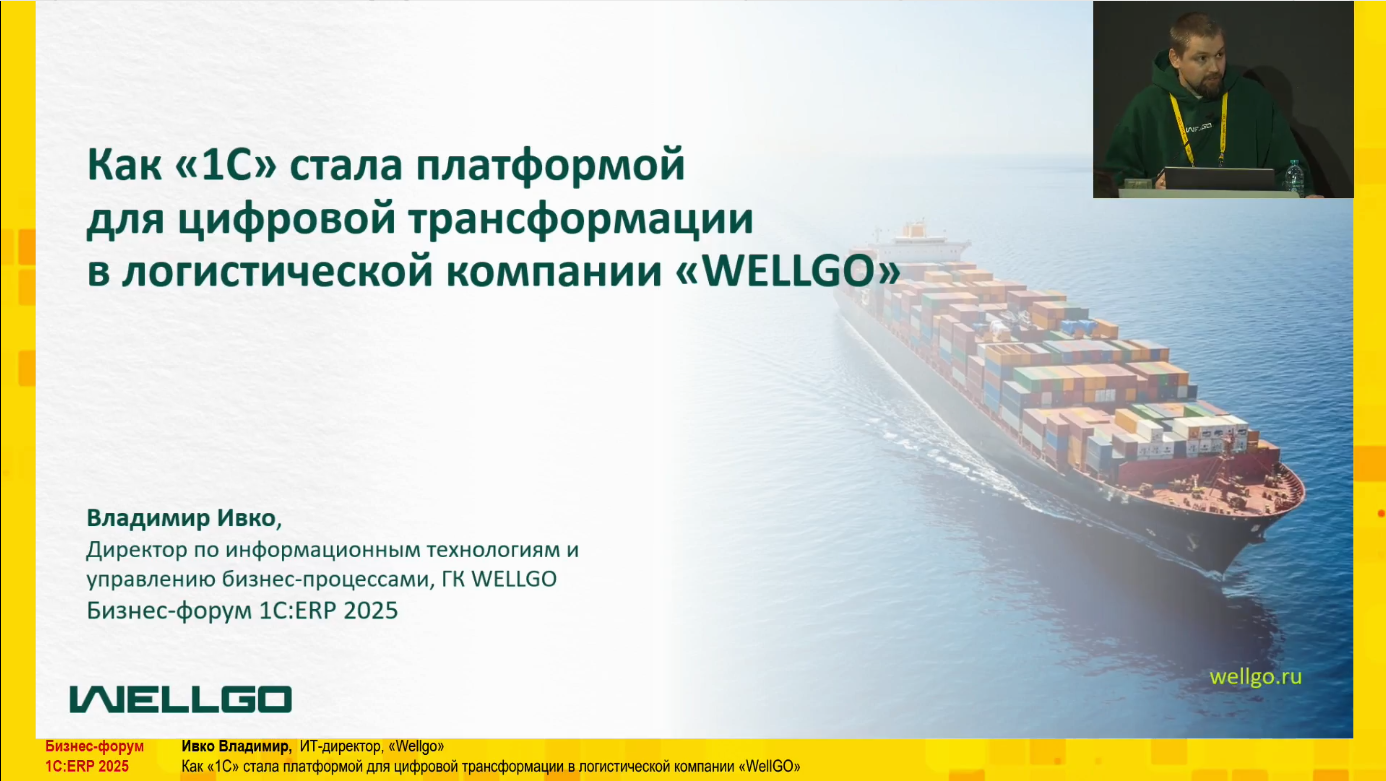
Vladimir Ivko , the company's Director of Information Technology and Business Process Management, spoke at the event. In his presentation, "How 1C Became a Digital Transformation Platform for WELLGO's Transport Logistics," he detailed the company's journey from fragmented accounting systems to the creation of a unified digital ecosystem for logistics capital management.
This year, WELLGO presented at the forum in one of the key thematic sections – “Procurement Management, Warehouse, Logistics and Transport”.
Vladimir Ivko , the company's Director of Information Technology and Business Process Management, spoke at the event. In his presentation, "How 1C Became a Digital Transformation Platform for WELLGO's Transport Logistics," he detailed the company's journey from fragmented accounting systems to the creation of a unified digital ecosystem for logistics capital management.
Vladimir outlined the context in which the changes began. The departure of foreign IT solutions and the legacy of disparate 1C systems led to a high manual workload for employees, delays in making changes, and a loss of control.
" We chose a strategy of developing the existing platform rather than replacing it. Given the transformation of the entire business from a corporate to a Russian one, this could have led to a loss of adaptation speed and competitiveness. Since all operational logic was already implemented in 1C, our goal was to transform it from an accounting system into a digital assistant for transport management," Vladimir explained. The "Single File" project was a key element of the transformation. As part of the project, extensive work was carried out to standardize data, clean up directories, and create a unified User Interface. Eliminating unnecessary operations freed up more staff time for what really matters – providing high-quality customer services.
The implementation of the "Single File" laid the foundation for the development of an internal transportation management system . Data became unified and manageable, enabling the transition from ad-hoc integrations to the use of an API bus for connecting clients and partners. This made processes transparent and allowed the use of 1C data for service quality management, rather than just reporting. Operational management subsequently transitioned from manual data entry to qualitative analytical management. The unified data structure also paved the way for the use of BI tools and the creation of a corporate data warehouse.
In conclusion, directions for further development were outlined, including the development of infrastructure integrations, the introduction of AI assistants, and the implementation of Data principles.
"For WELLGO, 2025 was a year of transition from 'doing' to 'understanding and managing.' We've become convinced that 1C can be the core of a powerful digital ecosystem for our business. Most importantly, the team's mindset has changed, for whom data has become a strategic asset," Vladimir concluded.
" We chose a strategy of developing the existing platform rather than replacing it. Given the transformation of the entire business from a corporate to a Russian one, this could have led to a loss of adaptation speed and competitiveness. Since all operational logic was already implemented in 1C, our goal was to transform it from an accounting system into a digital assistant for transport management," Vladimir explained. The "Single File" project was a key element of the transformation. As part of the project, extensive work was carried out to standardize data, clean up directories, and create a unified User Interface. Eliminating unnecessary operations freed up more staff time for what really matters – providing high-quality customer services.
The implementation of the "Single File" laid the foundation for the development of an internal transportation management system . Data became unified and manageable, enabling the transition from ad-hoc integrations to the use of an API bus for connecting clients and partners. This made processes transparent and allowed the use of 1C data for service quality management, rather than just reporting. Operational management subsequently transitioned from manual data entry to qualitative analytical management. The unified data structure also paved the way for the use of BI tools and the creation of a corporate data warehouse.
In conclusion, directions for further development were outlined, including the development of infrastructure integrations, the introduction of AI assistants, and the implementation of Data principles.
"For WELLGO, 2025 was a year of transition from 'doing' to 'understanding and managing.' We've become convinced that 1C can be the core of a powerful digital ecosystem for our business. Most importantly, the team's mindset has changed, for whom data has become a strategic asset," Vladimir concluded.